
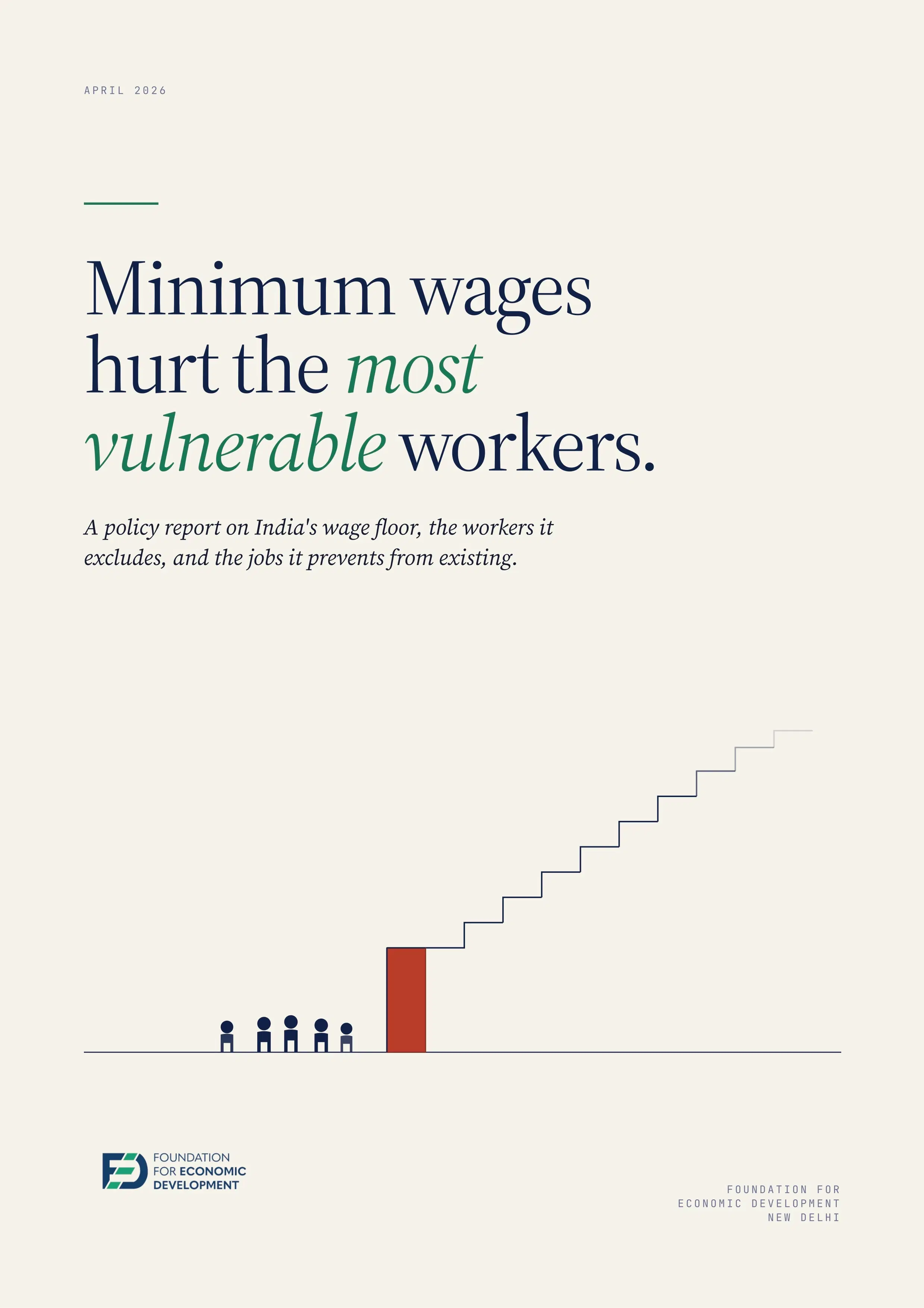
Minimum wages hurt
the most vulnerable workers.
A policy report on India's wage floor, the workers it excludes, and the jobs it prevents from existing.
Rigorous research repeatedly establishes that minimum wages reduce employment opportunities, especially for the least-skilled workers. India's floor sits at 169% of what the median casual worker earns and 50% above its major export competitors — priced for an economy that does not yet exist. For 47% of India's workers, hiring them at 30% above what they earn today would still be illegal.
A wage both sides would have agreed to —
and the law that stopped them.
The mechanism is not abstract. It plays out in millions of individual hiring decisions every year.
Laxmi would have earned ₹12,000. Aman would have hired her. The law stopped both of them.


India's floor is unusually high relative to its income and productivity.
Higher than median earnings. Higher than per-capita GDP benchmarks. Higher than NREGA. Higher than every major export competitor.
Employers have nine realistic options.
Only one helps workers.
When a wage floor is set above what firms can afford, employers don't simply pay more. They have a wide menu of choices — and almost all of them leave the worker worse off. Scaled up across the firms of an economy, these individual responses produce the data throughout this report.
“Among the papers providing the most credible evidence, almost all point to negative employment effects… studies focused on the least-skilled groups provide relatively overwhelming evidence of stronger disemployment effects.”
— Neumark & Wascher (2006) · Comprehensive literature reviewThe macro data from India follows this mechanism precisely. ~88% of the workforce is informal, labour-intensive sectors are growing at half the pace of capital-intensive ones, and the structural transition out of agriculture has been 40% slower than China's.
Tap each card to see the human impact →
Entry-level and unskilled workers are first to go when the floor exceeds their productivity.
Manual, repetitive roles disappear. Workers cannot retrain fast enough to stay employed.
All workers lose their jobs. Formal workers like Sunita are pushed into the informal economy.
Footwear, apparel, leather — the industries that absorb low-skill workers — shrink and stagnate.
Jobs exist — just not for Indian workers. India's $60bn export gap is the cost of this displacement.
Workers in high-floor states like Karnataka, who cannot easily move, lose jobs to Tamil Nadu.
Workers like Raju — willing to learn on the job — find no entry point. The first rung disappears.
Workers like Rekha end up without contracts, PF, or any legal protection — exactly what the law was meant to prevent.
Works only when firm productivity can absorb the cost. For most of India's labour market, it cannot.
40% to 79% of workers earn below the minimum wage —
in every major state.
The statutory minimum is not a binding price at the bottom of the labour market. It is a line most of the workforce already sits under.
Nationally, 64% of all workers earn below the minimum wage. In Odisha and Jharkhand, nearly 4 in 5 workers do.
Source · Periodic Labour Force Survey 2023–24; Directorate of Economics & Statistics of respective state governments
India's minimum wage sits 54% above its export competitors' average.
Measured as a proportion of monthly per-capita GDP, India's floor is an outlier among the economies it competes with for labour-intensive manufacturing investment.
Competitor average ≈ 50%. India sits 54% above this benchmark.
India and China each hold roughly a fifth of the world's low-skill labour. China captures 42% of low-skill global exports. India captures 7%. The gap, measured in unrealised trade, is roughly $60 billion a year.
“A policy intended to protect the most vulnerable has, instead, priced them out of the formal economy entirely.”
— Minimum Wages Hurt the Most Vulnerable Workers, FED 2026The sectors that could absorb the most workers
are growing the least.
Labour-intensive sectors grew at 7–9%. Capital-intensive sectors grew at 13–14%, roughly 1.7× as fast. The structural gap is not a coincidence.
These are not edge cases. They are what the data describes, made specific.
Each scenario reflects documented patterns of employer behaviour. Flip each card to read the full story.

Rekha stitches garments from her home for a local contractor who pays her ₹6,000 a month in cash. No written contract, no provident fund, no sick leave, no paid holiday. Her contractor once tried to register the arrangement formally. The labour inspector calculated what he would owe under the minimum-wage schedule and concluded the unit would not be viable. He let it drop. Rekha has never been offered the choice of a formal job — not because no one wanted to give her one.

Raju moved from a village in Odisha to Surat hoping to find work in the textile industry. Every unit he approached told him the same thing: they could only take on workers who could already operate specific machines, because the minimum wage meant they could not afford to train anyone from scratch. Raju had been willing to work for less while he learned. The law did not allow it. He returned home after two months without a job, his savings spent on rent.

For a decade, Kiran's life was defined by the growth of his precision-tooling unit and the pride of providing 200 formal jobs. The proposed minimum-wage hike threatens to make his operations 52% more expensive than competitors across the state border. Karnataka's minimum wage is already 7% higher than Tamil Nadu's. He now plans to relocate. The 200 jobs that existed in Karnataka will exist in Tamil Nadu. Kiran's workforce — most of whom cannot easily relocate — will be unemployed.

Sunita worked at a shoe-assembly unit in Agra until the factory closed last year. The owner, unable to compete with units operating informally in the same district or with manufacturers in Bangladesh, decided it was no longer viable to run a formal operation. She had worked there for six years, earning a stable wage with EPF contributions. She now sells vegetables from a handcart, earning less than half her previous income — with no social protection of any kind.
Tap any card to flip it and read the full story
China moved 300 million workers out of informality
in 30 years. India has not.
Informality rate (% of workforce) from the year of opening. China's structural transition was 40% faster — driven by labour-intensive export manufacturing that India's wage floor has largely prevented.
Decades of research, one consistent finding.
Rigorous RCTs, natural experiments and literature reviews consistently find negative causal effects — especially for the most vulnerable.
“Among the papers providing the most credible evidence, almost all point to negative employment effects… studies focused on the least-skilled groups provide relatively overwhelming evidence of stronger disemployment effects.”
Comprehensive review of the minimum wage literature
“There is a clear preponderance of negative estimates in the literature… strong and consistent evidence of negative employment effects for teens, young adults, the less-educated, and directly-affected low-wage workers.”
Updated comprehensive review
Employers were less likely to hire when required to pay a minimum wage, and when they did, they more often chose higher-skilled workers. Imposing a minimum wage led to a large reduction in the number of jobs posted overall.
Online job platform RCT — the gold standard of evidence
Exploiting the sharp wage jump of ~40% at age 18 in Denmark: employment fell by 33% and total hours worked fell by 45% among workers just crossing the age threshold.
Natural experiment · Denmark · Age-18 wage discontinuity
The path out runs through flexibility, not floors.
Respecting choices, allowing flexibility and expanding options are key to widening the path into formal employment for workers currently excluded.
A negotiated wage — even if it starts below the current floor — would allow many workers to enter formal employment for the first time, gaining contract and legal protections they currently lack entirely. Singapore's tripartite National Wages Council sets guidelines rather than a universal minimum.
Fiscally expensive but politically easier and economically sound: the state pays a fixed per-worker subsidy which, instead of reducing demand for workers like a minimum wage would, will provide higher demand for workers — while letting rising market wages narrow the gap.
The Code on Wages, 2019 empowers the Centre to set a national floor wage. A uniform floor would sit above the median in poorer states with surplus labour, making the majority of their workforces legally un-hireable. Firms weighing India vs. Bangladesh will decide on the all-in cost of labour.
| Recommendation | Constraint Addressed | Fiscal Cost | Political Difficulty |
|---|---|---|---|
| 01 · Free negotiation | Exclusion from formal jobs | None | High |
| 02 · Wage subsidies, not hikes | High floors make firms unviable | High | Low |
| 03 · No national floor | Poor states' competitive edge | None | Medium |
Press releases, op-eds and coverage.
The latest coverage, op-eds, and research updates on India's minimum wage debate.
Download the complete analysis, share with policymakers and industry leaders, and help shape India's sports goods export strategy.